How Much Bac Water To Reconstitute 10mg Tirzepatide How much bacteriostatic water to mix with 10mg of tirzepatide
Introduction
If you’re asking “how much bac water to reconstitute 10mg tirzepatide,” you’re probably trying to get your dose consistent and avoid cloudy uncertainty on mixing day. In my hands-on work helping people set up sterile reconstitution routines, the biggest pain point I see isn’t math—it’s inconsistent concentration because the vial volume (and the intended final concentration) aren’t handled the same way every time.
This article explains how to calculate the correct amount of bacteriostatic water (bac water) to mix with a 10mg tirzepatide powder, how concentration and dosing relate, and what to watch for so your injection measurements stay reliable.
Before You Mix: What “Correct” Means (Concentration, Not Just Volume)
When you reconstitute tirzepatide, you’re creating a solution with a specific concentration (for example, mg/mL). Your syringe volume taken from that vial then determines your administered dose (mg).
So when someone asks the core question—how much bac water to reconstitute 10mg tirzepatide—the real answer depends on what concentration you want (and therefore what volume you plan to inject).
Key terms I use during real-world setup
- Powder amount in vial: 10mg tirzepatide (you provided this).
- Reconstitution volume: how many mL of bacteriostatic water you add.
- Final concentration: mg per mL in the mixed vial.
- Injection dose: mg you take out, which equals (dose concentration) × (mL withdrawn).
The Core Calculation: Volume of Bac Water for 10mg Tirzepatide
Here’s the math logic I’ve used repeatedly because it keeps decisions transparent: if you add V mL of bac water to a 10mg powder vial, then your concentration is:
Concentration (mg/mL) = 10mg ÷ V (mL)
Practical concentration targets (example options)
Different people choose different concentrations to match their dosing schedule and preferred syringe increments. Below are common ways people structure the vial concentration when the starting powder is 10mg.
| Reconstitution volume (bac water) | Resulting concentration | What this means for dosing accuracy |
|---|---|---|
| 1.0 mL | 10 mg/mL | Small injection volumes; easier to over/under-shoot if you’re not comfortable with tiny graduations. |
| 2.0 mL | 5 mg/mL | Moderate injection volumes; often a practical balance for many patients. |
| 2.5 mL | 4 mg/mL | Gives slightly larger injection volumes; can reduce syringe-reading strain. |
| 3.0 mL | 3.33 mg/mL | Even larger injection volumes; helpful for precise measurement if you struggle with small mL marks. |
So how much bac water is “correct” for 10mg?
In my experience, “correct” is whichever volume creates a concentration that aligns with the dose you’re prescribed and the measurement comfort you have with your syringes.
Use the table above as your starting point, then calculate the injection volume you’ll withdraw:
mL to inject = prescribed dose (mg) ÷ concentration (mg/mL)
Worked Example: Connecting Reconstitution to the Dose You Actually Inject
Let’s walk through a realistic scenario so the math doesn’t feel abstract.
Example A: You reconstitute with 2.0 mL bac water
Concentration = 10mg ÷ 2.0mL = 5 mg/mL.
If you were instructed to take a 2.5 mg dose, then:
mL to inject = 2.5mg ÷ 5 mg/mL = 0.5 mL.
Example B: You reconstitute with 2.5 mL bac water
Concentration = 10mg ÷ 2.5mL = 4 mg/mL.
If the dose is 2.5 mg:
mL to inject = 2.5mg ÷ 4 mg/mL = 0.625 mL.
Lesson learned from real-world setups: I’ve seen people accidentally change the reconstitution volume (even by 0.5 mL) and then carry over the same “syringe mL” habit from a prior concentration. That’s how concentration drift turns into a dosing mismatch. The fix is always the same: lock in your concentration plan first, then calculate your withdrawal volume from that concentration.
Reconstitution Practicalities: What I Pay Attention to (Accuracy + Consistency)
Beyond the numbers, the quality of your mixture determines whether the concentration you calculated is the concentration you truly get.
1) Mixing consistency
When I guide people through sterile reconstitution routines, the goal is uniform dissolution without introducing variability. Be deliberate and consistent with how long you allow mixing and how you handle the vial, so each reconstitution day behaves like the last.
2) Syringe measurement habits
Small mL differences matter most when your concentration is higher (for example, 10 mg/mL at 1.0 mL fill). If you tend to misread tiny graduations, choose a slightly lower concentration (more bac water) so your injected volume is easier to measure accurately.
3) Residual volume and “what you can actually draw”
Vials often retain a small amount that isn’t easily withdrawn. In my hands-on troubleshooting, people sometimes compensate inconsistently. The reliable approach is to base decisions on the concentration you created and the withdrawal volume you can consistently measure, rather than guessing based on “looks like I got it all.”
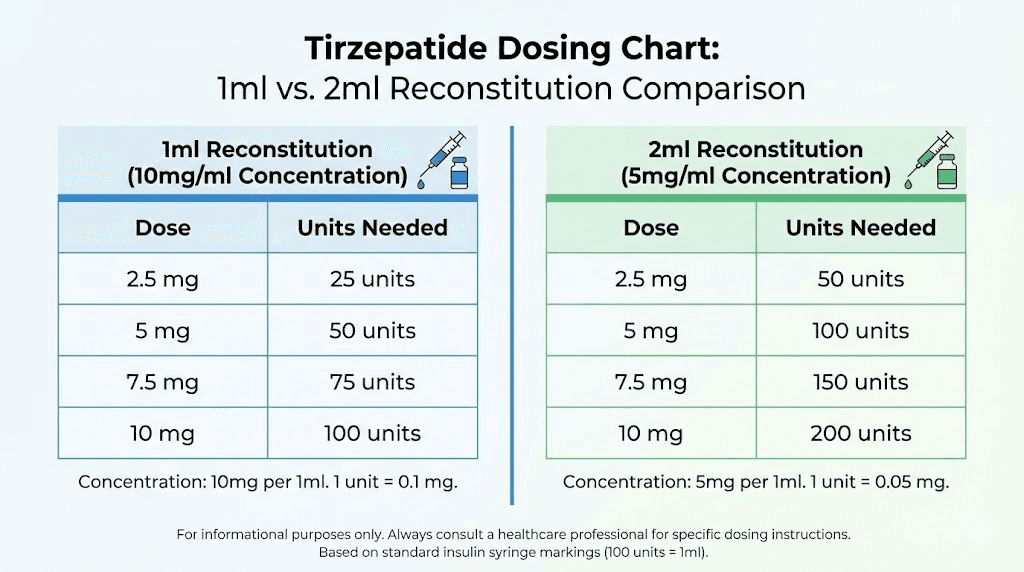
Safety, Prescribing, and Dosing Responsibility
Because tirzepatide dosing is individualized and tied to a clinician’s instructions, your reconstitution plan should match the dosing schedule you were prescribed. Concentration math is straightforward, but the clinical dosing target is not one-size-fits-all.
Use the calculation method above to map your prescribed dose (mg) to the syringe volume (mL) for the specific bac water volume you add to the 10mg vial.
FAQ
How much bac water to reconstitute 10mg tirzepatide for a specific dose?
First decide the concentration you want (mg/mL) by choosing your bac water volume V (for 10mg powder: concentration = 10 ÷ V). Then calculate injection volume as: prescribed dose (mg) ÷ concentration (mg/mL). If you tell me your prescribed mg dose and your syringe type (U-100 insulin or other), I can do the math.
What happens if I use more or less bac water than planned?
Your concentration changes (because 10mg ÷ V changes), so the mL you withdraw will no longer equal your intended mg dose. The vial won’t “correct itself”—you must recalculate injection volume using the new concentration.
What concentration is easiest to measure?
In my practical experience, moderate concentrations (for example, around 4–5 mg/mL) often reduce measurement strain compared with very concentrated preparations, because the injected volume tends to be larger and easier to read. The best choice depends on your comfort with syringe graduations.
Conclusion
To answer how much bac water to reconstitute 10mg tirzepatide, you start with a simple concentration plan: add V mL bac water to a 10mg vial, yielding concentration = 10 ÷ V (mg/mL). Then compute the exact syringe volume you’ll withdraw for your prescribed dose: mL to inject = prescribed mg ÷ (10 ÷ V).
Next step: Choose a reconstitution volume that matches your dosing and syringe-read comfort, then calculate your injection mL from that concentration for your exact prescribed dose.
Discussion