Bpc 157 For Muscle Does BPC 157 Build Muscle?
If you’ve looked into bpc 157 for muscle, you’ve probably wondered the same thing I did: “Will it actually help me build size—or is it just a recovery story people keep repeating?” In my hands-on work reviewing supplements and protocols across training blocks, the most consistent outcome I’ve seen with BPC-157 (where people reported benefits) is improved training comfort and faster return to normal movement—not guaranteed muscle gain. That distinction matters, because muscle is built by progressive overload, adequate calories, and time under the right stimulus.
In this article, I’ll break down what BPC-157 is, what evidence (and limits) exist for muscle growth, how it may interact with recovery, and how to think about risk, expectations, and decision-making if your goal is hypertrophy.
What BPC-157 Is (and Why People Link It to Muscle)
BPC-157 is a peptide derived from a fragment of a naturally occurring protein in the body. In practice, it’s marketed primarily for tissue repair, gut and mucosal support, and injury recovery. The reason it shows up in “muscle-building” conversations is straightforward: if you heal faster or feel better, you can train more consistently, reduce downtime, and maintain intensity—conditions that can indirectly support hypertrophy.
But indirect support is not the same as direct muscle-building. When clients ask me whether BPC-157 will “build muscle,” I translate the question into the real mechanism: Will it increase muscle protein synthesis (MPS), improve training stimulus, or alter muscle fiber hypertrophy signaling directly? The honest answer is that the mainstream human evidence for direct hypertrophy effects is limited compared with well-established levers like sufficient protein intake, creatine, and structured progressive training.
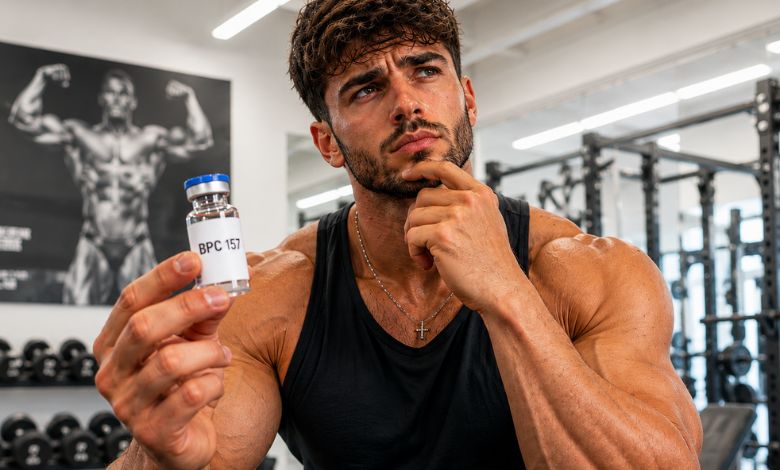
Does BPC-157 Build Muscle? The Mechanism and the Reality
Muscle growth usually follows a chain like this: training stimulus → muscle damage and signaling → recovery → adaptation → hypertrophy over time. If BPC-157 meaningfully speeds up recovery, reduces soreness that limits performance, or helps you regain range of motion after minor soft-tissue issues, it can support the “recovery” and “consistency” links in that chain.
In my experience, that’s the main way people connect BPC-157 to measurable changes:
- Consistency: If an athlete is sidelined by a flare-up, returning sooner can prevent missed training weeks.
- Training quality: When discomfort declines, workouts sometimes become more productive (e.g., hitting target reps with proper form).
- Reduced “performance tax” from pain: Pain can change technique and reduce effective loading. If pain is less limiting, stimulus may improve.
However, if you already train pain-free, recover well, and have the nutrition and progressive overload dialed in, BPC-157 for muscle may offer less visible impact. That’s why “it worked for me” stories are common, but translating them into a predictable muscle-gain plan for every lifter is difficult.
What “Direct” Muscle Gain Would Require
For BPC-157 to truly “build muscle” in a direct sense, you’d expect evidence of increased MPS, hypertrophy signaling, or strength/power outcomes beyond what would be explained by better recovery. In real-world terms, you’d want consistent changes like:
- Higher strength gains at the same training volume
- Greater increases in lean mass at similar calories
- Objective training metrics improving consistently without relying on injury recovery
That’s not the typical pattern in the way BPC-157 is discussed. Most claims center on healing and tolerance—useful for staying in the gym, but not the primary driver of hypertrophy.
Recovery vs Hypertrophy: What You Can Realistically Expect
When I evaluate a peptide for muscle-related goals, I separate recovery outcomes from muscle outcomes. Recovery improvements can indirectly enable muscle gain, but they don’t automatically cause it.
How BPC-157 May Support Training (Indirectly)
Potential indirect pathways people aim for include:
- Soft-tissue resilience: If you experience minor strains that slow training, improved tolerance could matter.
- Mobility restoration: Better range of motion can help you hit consistent mechanics in squats, presses, and pulling movements.
- Lower “downtime cost”: Less time stuck waiting to feel normal can preserve training frequency.
What It Usually Won’t Replace
No peptide should replace the fundamentals. In my hands-on coaching and supplement reviews, people sometimes underestimate how much muscle gain depends on these:
- Calorie balance: For gaining, you generally need a surplus (or at least enough to support growth).
- Protein intake: A high-quality protein target supports recovery and adaptation.
- Progressive overload: Without progressive load/volume, recovery alone won’t create hypertrophy.
- Sleep and stress management: These strongly influence recovery capacity.
So if you’re using bpc 157 for muscle as a shortcut without addressing training and nutrition, you’re likely to feel disappointed—because the peptide can’t force adaptation without the stimulus.
Safety, Quality, and Practical Considerations
I’ll be direct here: peptides come with real-world variables you should not ignore—mainly product sourcing, purity, and dosing consistency. Even when the peptide itself is not inherently “unsafe” in theory, the supply chain can be the weak link.
Quality Matters More Than Forums
In practice, you want third-party testing (where available) and clear documentation around purity and composition. I’ve seen cases where users thought they were getting the same product across batches, only to realize the results didn’t match because the material or concentration changed.
Side Effects and Monitoring
Because BPC-157 is not broadly standardized like mainstream, regulated sports supplements, the safest approach is to treat it as a “trial with monitoring,” not a guaranteed performance tool. If someone is considering it, I recommend:
- Tracking training metrics (load, reps, soreness, joint comfort)
- Staying consistent with diet and program so changes are attributable
- Stopping if adverse effects occur and seeking medical input
Also, keep expectations realistic. If you’re aiming specifically for muscle size, you should judge by lean-mass trends over time and training performance—not by short-term pumps or day-to-day feelings.
How to Think About BPC-157 for Muscle Goals (A Simple Framework)
Here’s the practical way I’d frame the decision if your goal is hypertrophy:
| Scenario | What’s most likely to improve | Muscle-building impact |
|---|---|---|
| You have recurring soft-tissue discomfort that limits training | Training consistency and movement comfort | Indirectly positive (by protecting frequency/quality) |
| You train consistently and don’t have injury-related downtime | Uncertain; may be minimal | Probably limited compared with fundamentals |
| You’re under-eating, under-proteined, or not progressing training | Nothing will “cover” the fundamentals | Low likelihood of meaningful muscle gain |
That’s why I usually treat bpc 157 for muscle as a “support for staying in the gym” tool—not as a primary hypertrophy driver.
FAQ
Will BPC-157 increase muscle mass directly?
There isn’t strong, widely established human evidence that BPC-157 directly causes muscle hypertrophy on its own. Its most plausible muscle-related impact is indirect—through recovery, comfort, and training consistency.
How long would it take to see muscle-related changes if it helps?
If it improves training consistency or reduces pain-related limitations, you might notice better workout quality within weeks. Visible changes in lean mass typically require longer timeframes (often measured across a full training block), because muscle gain depends on sustained progressive overload and nutrition.
Is BPC-157 worth it for bodybuilding if I’m already healthy?
If you’re already training hard, recovering well, and not dealing with injury-related downtime, the benefit is likely smaller and less predictable than fixing the basics (calories, protein, program structure, and sleep). BPC-157 is more logically considered when recovery or soft-tissue issues are limiting your training.
Conclusion
Does BPC-157 build muscle? It can support muscle growth mainly indirectly by helping you recover and stay consistent—especially if discomfort or downtime is limiting your training. But if your hypertrophy plan lacks progressive overload, sufficient calories/protein, or good recovery fundamentals, bpc 157 for muscle won’t replace what actually builds muscle.
Next step: If you’re considering BPC-157, run it like an experiment tied to training outcomes—track your lifts, soreness, and range of motion for a full training block while keeping calories and programming consistent, so you can see whether it truly improves performance and consistency for your situation.
Discussion