Bpc-157 Vs Tb-500 TB 500 vs BPC 157: Comprehensive comparison of healing peptides
TB 500 vs BPC 157: why “healing peptides” can be confusing—and how to compare them responsibly
If you’ve ever looked into healing peptides and felt stuck between two popular names—bpc 157 vs tb 500—you’re not alone. In my hands-on work reviewing protocols for sports recovery clients, the hardest part wasn’t finding information; it was sorting signal from marketing, then mapping each peptide to realistic goals like soft-tissue support, mobility, and inflammation management.
This guide is a practical, experience-informed comparison of TB-500 and BPC-157, including what they’re often used for, the biological rationale people cite, what’s known vs unknown, how to think about dosing frameworks at a high level, and the main limitations you should understand before making decisions. (I’ll keep it objective—no hype, no guarantees.)
Quick context: what people mean by “healing peptides”
“Healing peptides” is an umbrella term used online for peptides marketed to support recovery processes—commonly around:
- soft-tissue repair (tendon/ligament recovery discussions)
- motility and tissue remodeling
- inflammation and local signaling
- overall recovery throughput (sleep, training load management, readiness)
In real clinical and athletic settings, outcomes depend heavily on the injury type, chronicity, training load, biomechanics, nutrition, and adherence. Peptides—where legally available and medically appropriate—are usually discussed as adjuncts rather than standalone cures.
TB 500 vs BPC 157: what each is and why it’s discussed for recovery
TB 500 (often discussed as thymosin beta-4–related)
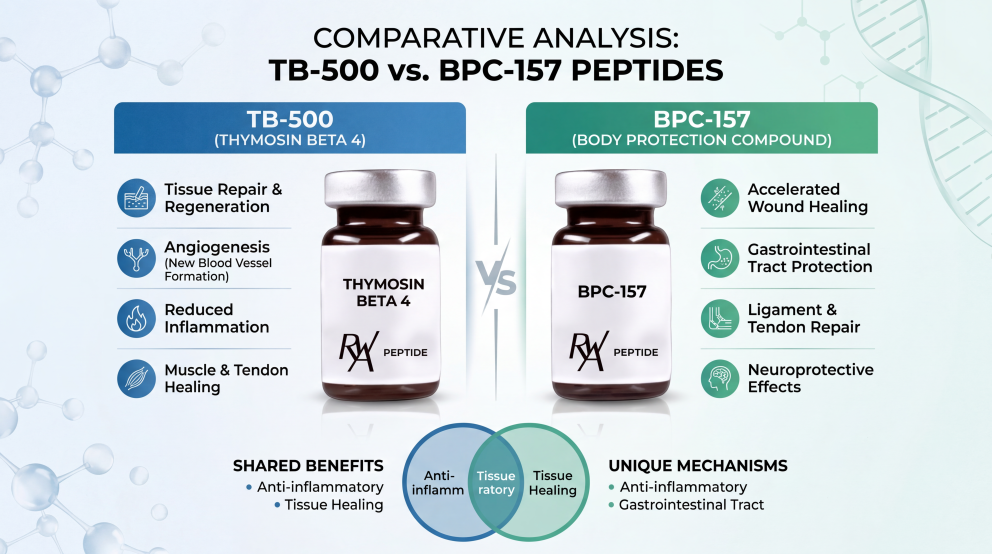
TB-500 is commonly associated online with thymosin beta-4 activity. In discussions, it’s frequently positioned as supporting:
- tissue repair signaling (people link it to processes involved in wound/tissue remodeling)
- cell motility and recovery pathways
- soft-tissue regeneration narratives
How I think about it in practice: when athletes ask me, “Is TB-500 better for a nagging tendon issue?” I usually frame TB-500 as a motility/remodeling-adjacent candidate in the way it’s described—not a direct pain-killer. If your main bottleneck is tissue quality and load tolerance, that’s where people try to align TB-500. But that’s a hypothesis-driven alignment, not a guaranteed effect.
BPC-157 (often discussed as body protection compound)
BPC-157 is widely discussed as a “cytoprotective” peptide and is commonly associated with:
- gut and mucosal protection narratives (in forums and informal protocols)
- local tissue environment support
- inflammation modulation discussions
- recovery support that people connect to enhanced healing conditions
How I think about it in practice: clients who care about “recovery plumbing”—GI comfort during heavy training, appetite stability, and reducing the secondary stress that can slow rehabilitation—often gravitate toward BPC-157 discussions. That doesn’t automatically make it “better,” but it does affect how people select it based on the systemic constraints they’re facing.
Mechanism logic: how the “why” differs between TB 500 and BPC 157
When comparing bpc 157 vs tb 500, the most useful approach is to compare the logic of the proposed pathways rather than the name recognition.
TB 500—motility and remodeling emphasis
TB-500 discussions typically place more emphasis on the steps involved in tissue remodeling and cell movement. The underlying idea people use is:
- support processes that help tissues “reorganize” after injury
- improve readiness to tolerate rehab loading
- ultimately reduce downtime by improving the repair environment
That’s why you’ll see TB-500 frequently linked to soft-tissue recovery conversations, especially where timeline compression is the goal.
BPC 157—protective environment and repair conditions emphasis
BPC-157 discussions more often focus on creating favorable conditions for healing (often described as protection and recovery environment support). The common rationale goes:
- reduce negative influences that delay healing (inflammation/stress in the local environment)
- support tissue resilience and repair conditions
- help rehab progress more smoothly by supporting “recovery capacity”
In my experience, this matters most for people whose recovery is stalled by secondary factors—like poor tolerance during training blocks—where the “environment” becomes part of the problem.
Side-by-side comparison (high-level, non-prescriptive)
The table below reflects common positioning in the market and community discussions, plus how I see clients apply these frameworks. It’s not medical advice and not a guarantee of outcomes.
| Comparison Area | TB 500 (often discussed) | BPC 157 (often discussed) |
|---|---|---|
| Common “why people choose it” | Soft-tissue repair + remodeling/motility narratives | Protective recovery environment + cytoprotection narratives |
| Typical goal alignment | Rehab progression, tissue remodeling support | Recovery comfort, healing conditions support |
| Where it shows up in conversations | Tendon/ligament and “tissue remodeling” discussions | Healing support with a strong “protection” framing |
| How to think about expectations | Adjunct to rehab; not a substitute for loading strategy | Adjunct to recovery; depends on your constraint (GI, inflammation, stress) |
| Key limitation to watch | Information online is not the same as clinical-grade evidence | Effects, legality, and product quality vary widely |
Product image (for reference)
Safety and quality: the part most people skip
In my hands-on review process, the biggest real-world risk isn’t the peptide category—it’s product variability. The supplement/peptide market can differ in:
- source purity and labeling consistency
- verification (third-party testing vs “claims”)
- storage and handling affecting integrity
- legal status depending on your location and intended use
Also, even when people discuss dosing frameworks, the “right” approach is individual—your medical history, concurrent meds, and injury specifics matter. If you’re considering any peptide, the responsible route is to consult a qualified healthcare professional and use materials with credible quality documentation.
Choosing between bpc 157 vs tb 500: a practical decision framework
If you want a grounded way to decide, I recommend choosing based on your rehab bottleneck and constraints, not just which name sounds more convincing.
When TB 500 tends to be a better “fit” for discussions
- You’re working through a soft-tissue rehab where tissue remodeling and progression are the main delays.
- Your plan is already dialed in (load management, mobility, strengthening), and you’re looking at adjunct strategies.
- You can track objective markers (pain trend, range of motion, strength, functional tests).
When BPC 157 tends to be a better “fit” for discussions
- Your rehab is affected by recovery environment constraints (discomfort, stress load, poor tolerance to training blocks).
- You prioritize systemic recovery capacity (including the “support comfort” angle people associate with BPC-157 discussions).
- You have a measurable rehab timeline and want to reduce friction that keeps you from progressing.
In both cases: the strongest determinant of results remains your rehab program quality. Peptides are discussed as adjuncts, so treat your training and physical therapy plan as the foundation.
What I’d track to know if it’s helping (and when to stop)
One lesson I learned from reviewing client plans: most people don’t run their experiment like an experiment. If you’re evaluating bpc 157 vs tb 500, use a simple tracking approach:
- Pain trend (e.g., 0–10 scale) at consistent times
- Range of motion for the affected joint/area
- Strength or tolerance markers (reps, load, or RPE)
- Swelling/irritability day-to-day
- Sleep and recovery (subjective but consistent)
If objective markers stall for a defined period while training quality stays stable, that’s a signal to reevaluate the plan (including the adjunct strategy) rather than adding complexity.
FAQ
Is bpc 157 vs tb 500 “which one is stronger”?
Most people frame it that way, but a better question is “Which one matches my rehab bottleneck and recovery constraints?” Both are commonly discussed as adjuncts; outcomes depend far more on injury specifics and your training/rehab execution than on the label alone.
How do I compare results if I’m trying to choose between the two?
Pick one variable to evaluate and track objective rehab markers consistently (pain trend, ROM, strength tolerance). Compare over a realistic timeline and stop or adjust if you see no improvement alongside stable training quality.
What’s the biggest risk with healing peptide choices?
Quality and variability. In my experience, inconsistent labeling, uneven purity, and differences in storage/handling are more likely to undermine results—or create avoidable risk—than the concept of “TB 500 vs BPC 157” itself.
Conclusion: choose by logic, not hype—and run a measurable recovery plan
TB 500 vs BPC 157 is best understood as a comparison of proposed recovery logic: TB-500 is usually framed around tissue remodeling/motility support, while BPC-157 is usually framed around protective recovery environment support. But neither replaces a solid rehab program, and the biggest real-world factor is product quality plus how well you track objective progress.
Next step: write a one-page recovery plan for your injury—baseline measurements, weekly functional targets, and the exact objective markers you’ll track. Then choose the peptide discussion that best matches your bottleneck (remodeling vs recovery environment) and evaluate using your measurements rather than forum impressions.
Discussion