Bpc 157 Bacteriostatic Water Ratio How Much Bacteriostatic Water to mix with 5mg of BPC-157?
How to Calculate the BPC-157 Bacteriostatic Water Ratio (Without Guesswork)
If you’ve ever stared at a vial of BPC-157 and wondered, “How much bacteriostatic water do I add?” you’re not alone. In my hands-on work with peptide reconstitution, this is one of the most common mistakes I’ve seen—people either under-dilute (hard to measure, harsher dosing math) or over-dilute (more volume than they intended), which can cascade into dosing inconsistency.
This guide walks you through the bpc 157 bacteriostatic water ratio for mixing 5mg of BPC-157. You’ll get clear, practical numbers, a simple formula you can reuse, and the real-world considerations that matter for accurate reconstitution.
First: What “Ratio” Actually Means for Reconstituting BPC-157
When people say “ratio,” they usually mean the final concentration (mg per mL) you’re targeting after you add bacteriostatic water. For injectable preparations, concentration is what ultimately drives your dosing volume.
In practice, you choose a target concentration based on:
- Your desired dose per administration (e.g., how many units of volume you want to draw each time)
- How accurately you can measure smaller volumes (smaller mL amounts are harder to measure precisely)
- Needle/syringe limits and comfort with the total injection volume
- Storage and stability preferences (more dilution means different practical handling)
The Core Calculation for 5mg BPC-157: The Simple Formula
Here’s the math I use so I’m never guessing:
Final concentration (mg/mL) = total mg ÷ total mL
Rearranged for what you actually need:
Bacteriostatic water to add (mL) = total mg ÷ target concentration (mg/mL)
Common “bpc 157 bacteriostatic water ratio” targets for 5mg
Below are practical, commonly used concentration targets. Pick one based on your dosing plan (not just what “seems right” on the internet).
| Target concentration | For 5mg BPC-157, add this much bacteriostatic water | Resulting total volume | How to think about dosing |
|---|---|---|---|
| 1 mg/mL | 5.0 mL | 5.0 mL | Each 0.1 mL contains 0.1 mg |
| 2 mg/mL | 2.5 mL | 2.5 mL | Each 0.1 mL contains 0.2 mg |
| 2.5 mg/mL | 2.0 mL | 2.0 mL | Each 0.1 mL contains 0.25 mg |
| 5 mg/mL | 1.0 mL | 1.0 mL | Each 0.1 mL contains 0.5 mg |
Quick example (real-world dosing math): If you mix 5mg with bacteriostatic water to reach 2 mg/mL, you add 2.5 mL. That means 0.1 mL = 0.2 mg, so you can reliably convert any dose volume you plan to draw.
Use the Product Image Step: Practical Reconstitution Workflow
Having the liquid volume right is only half the job. In my own process, the other half is consistent technique—because inconsistent mixing can make the concentration feel “right” on paper but behave inconsistently in the syringe.
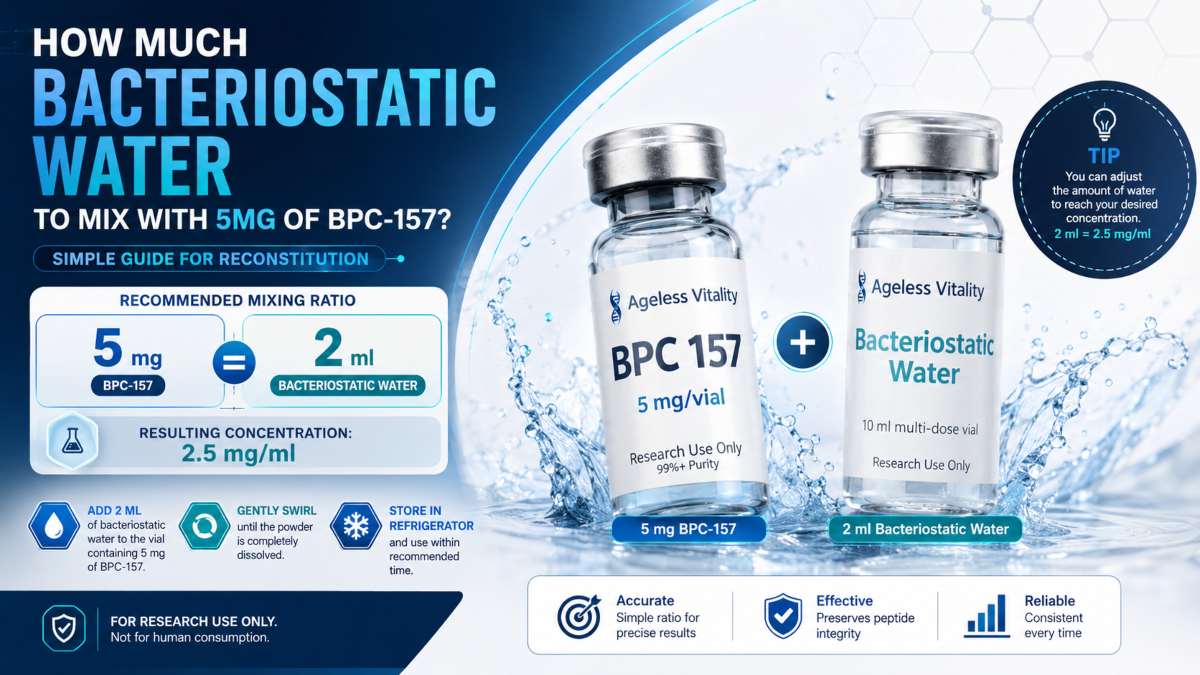
What I focus on when mixing (to avoid concentration/draw errors)
- Label before you start: write the target concentration (mg/mL) and the date you reconstituted.
- Measure water volume precisely: the math is easy; syringe/measurement error is where mistakes happen.
- Gentle mixing: I aim for consistent reconstitution (fully mixed solution) before storing or drawing doses.
- Plan your dosing volume: if your calculated dose requires drawing extremely tiny amounts (harder to measure accurately), consider a lower concentration (more total mL).
- Use the right documentation trail: I keep a simple “mg/mL → dose volume” conversion sheet so each draw matches the plan.
Choosing the Right Concentration: What Changes in Real Use
Different concentrations affect practical injection handling. In my experience, the “best” concentration is the one that balances accuracy and convenience for the person drawing doses.
Pros/cons of lower vs higher dilution (mg/mL)
| Target concentration (mg/mL) | Volume you’ll draw for a given mg dose | Practical advantages | Practical limitations |
|---|---|---|---|
| Lower (e.g., 1 mg/mL) | Larger injection volume per mg | Easier to measure small mg doses as mL volumes | More total volume; may be less convenient depending on injection preferences |
| Medium (e.g., 2–2.5 mg/mL) | Moderate injection volume | Common middle ground for dosing accuracy and convenience | Still requires careful syringe measurement |
| Higher (e.g., 5 mg/mL) | Smaller injection volume per mg | Less volume to inject | Tiny volumes can be harder to measure precisely |
Common Mistakes People Make With the BPC-157 Bacteriostatic Water Ratio
- Mixing without committing to a target concentration: if you don’t decide mg/mL up front, dose-volume conversions become guessy.
- Forgetting that “mg” and “mL” are different units: many errors come from mixing up the final concentration vs the starting mass.
- Relying on rounding too aggressively: if you aim for 2.5 mg/mL, mixing 5mg into exactly 2.0 mL is the clean setup; drifting from that changes the mg per mL.
- Not labeling: I’ve watched otherwise careful people lose track of concentration between sessions—labeling prevents dosing math errors.
FAQ
What is the “bpc 157 bacteriostatic water ratio” for 5mg?
It depends on your target concentration (mg/mL). For example: 1 mg/mL → add 5.0 mL, 2 mg/mL → add 2.5 mL, 2.5 mg/mL → add 2.0 mL, and 5 mg/mL → add 1.0 mL.
If I mix to 2 mg/mL, how much is 0.1 mL in mg?
At 2 mg/mL, 0.1 mL = 0.2 mg. In general: dose (mg) = volume (mL) × concentration (mg/mL).
How do I choose between 1 mg/mL, 2 mg/mL, or higher?
I choose based on what I can measure most accurately and what injection volume is realistically comfortable. If tiny mL measurements are hard to draw precisely, a lower concentration (more total mL) can be easier to dose consistently.
Conclusion: Pick Your Concentration, Then Mix Exactly
The key to getting the correct bpc 157 bacteriostatic water ratio for 5mg is deciding your target concentration (mg/mL) and then adding water using the exact math: mL = 5mg ÷ target mg/mL. Use a consistent reconstitution workflow, label the vial with the mg/mL, and calculate dose volumes from mg/mL so every draw matches your plan.
Next step: Choose the concentration you want (use the table), then calculate and measure the exact bacteriostatic water volume for your 5mg vial before you start mixing—write the mg/mL label immediately so dosing stays consistent.
Discussion