Mixing Peptides With Bac Water how to draw bac water How much bacteriostatic water to add to peptides: complete mixing guide
Introduction
If you’ve ever opened a vial of peptides and thought, “Am I adding bacteriostatic water the right way—especially the right amount?” you’re not alone. In my hands-on work, the most common mistakes I see aren’t about “bad peptides,” they’re about sloppy reconstitution: uneven mixing, lingering clumps, or miscalculated dosing volumes that throw off your intended concentration.
This guide explains mixing peptides with bac water with a practical, repeatable approach—so you can reconstitute reliably, reduce foam and dead space, and get consistent results every time.
What “Bacteriostatic Water” Does (and Why Mixing Matters)
Bacteriostatic water (often abbreviated “BAC water”) is sterile water containing a bacteriostatic agent intended to inhibit microbial growth. That helps keep reconstituted solutions from becoming contaminated during typical use windows.
However, BAC water only supports stability if the rest of the process is solid. The real challenge is that peptide powders are not always instantly soluble at room temperature. Mixing peptides with bac water matters because good mixing:
- Improves wetting of the powder (faster dissolution)
- Reduces persistent “floating” particles or streaks on the vial wall
- Improves uniform concentration (important for accurate dosing)
- Helps you avoid extra volume changes from aggressive foaming
In my lab-style workflow, I treat mixing as a quality-control step. I don’t just “shake and hope”—I use a consistent method that minimizes bubbles and ensures the peptide contacts the solvent evenly.
How Much BAC Water to Add: The Reconstitution Math
The amount of bac water you should add depends on what concentration you want (commonly expressed in mg/mL) and the peptide’s starting mass (commonly given in mg).
Core formula (mg/mL)
Target concentration (mg/mL) = Peptide mass (mg) ÷ Total volume (mL)
So, Total volume (mL) = Peptide mass (mg) ÷ Target concentration (mg/mL)
Quick example
- Peptide powder: 10 mg
- Target: 5 mg/mL
- Required volume = 10 ÷ 5 = 2 mL of bac water
Practical conversion tips I use
- If your dosing plan is based on units, convert those units into an equivalent mg/mL target first, otherwise you’ll reconstitute to the wrong concentration.
- Be consistent about your measurement method: use the same syringe/marking style each time.
- Plan your draw sizes: it’s easier to reconstitute to a concentration that matches your typical daily needs than to “stretch” solutions later.
Step-by-Step: Complete Mixing Guide for Peptides with BAC Water
Below is a clean, repeatable method I’ve used to reduce incomplete dissolution and concentration variability. The goal is even mixing with minimal foam.
Materials
- BAC water
- Peptide vial
- Sterile syringe(s) and needle(s) appropriate for vial access
- Alcohol swabs for vial tops
- A clean, stable work surface
1) Calculate your volume before you open anything
I recommend calculating the exact bac water volume you need using the mg/mL math above. When you do the math first, you avoid the most time-consuming failure mode: adding too much or too little and then trying to “fix” it mid-process.
2) Prepare the vial and environment
- Use a clean workspace.
- Wipe the vial stopper with an alcohol swab and let it dry.
- Ensure your bac water vial is also prepared and handled carefully.
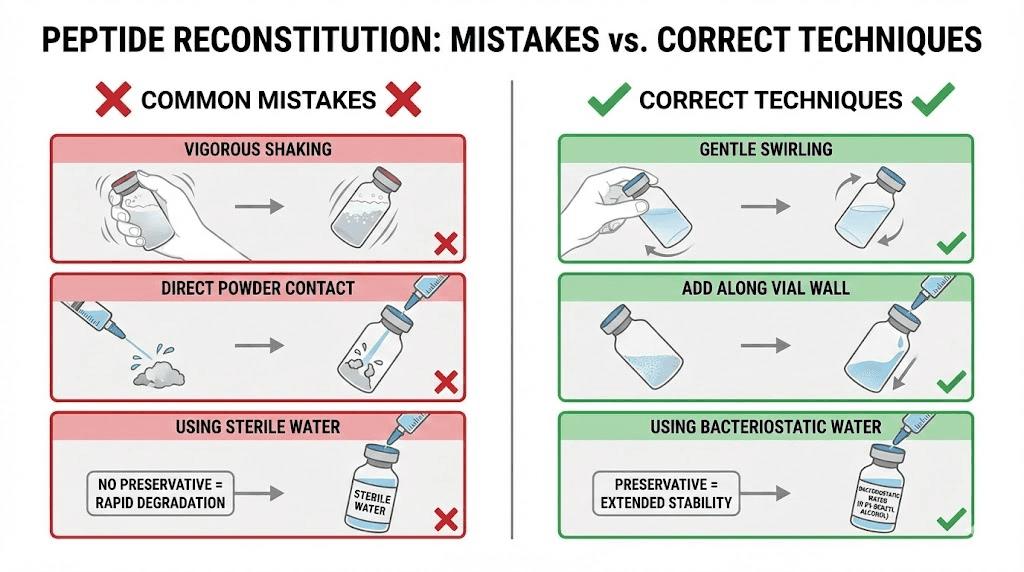
3) Add bac water with a controlled technique
In my hands-on experience, the technique matters as much as timing:
- Insert the needle through the stopper smoothly.
- Dispense the bac water gently so you don’t create excessive bubbles.
- Aim for contact with the powder—avoid “spraying” the stopper area repeatedly.
4) Mix using the right motion (not just shaking)
My consistent approach is to combine gentle agitation with time:
- Let the bac water fully contact the peptide for a brief moment before aggressive mixing.
- Use gentle swirling or slow inversion-style mixing to wet the entire powder.
- Pause if you see lots of foam; continue once bubbles settle.
5) Know when you’re “done” (dissolution cues)
What “complete mixing” looks like:
- More uniform solution with no visible powder clumps
- Reduced streaks along the vial wall
- Consistent appearance after a short recheck
If the peptide still looks particulate after a reasonable mixing period, don’t keep violently shaking—switch to a gentler, longer dissolution approach (and ensure temperature is reasonable for solubility). Different peptides dissolve at different rates.
6) Reduce dead space and prevent concentration drift
Concentration errors can happen even when math is correct. Two common issues:
- Left-behind volume: some residual solution remains in the vial/needle path. Your drawn volume may be less than you think.
- Inconsistent mixing between draws: if you withdraw aliquots without ensuring uniform suspension, you can get variability.
My rule: mix thoroughly, then withdraw your planned aliquots, and avoid long gaps that let particulates settle if they’re still present.
7) Record your batch concentration and mixing date
Write down the starting peptide mass, the added bac water volume, and the resulting mg/mL concentration. In real-world workflows, this documentation prevents repeat dosing mistakes.
Troubleshooting: Common Problems When Mixing Peptides with BAC Water
Problem: Powder won’t dissolve
What I do first: I reduce “shake intensity” and switch to gentle swirl + time. If there’s still visible particulate, it may be a solubility/dissolution-rate mismatch for that specific peptide.
Problem: Too much foam
- Dispense more gently on the next batch.
- Allow bubbles to dissipate before continuing.
- Prefer swirling over vigorous shaking.
Problem: Inconsistent concentration between doses
This typically comes from incomplete dissolution or uneven mixing between withdrawals. I treat mixing as a repeatable step and ensure the solution looks uniform before drawing.
Problem: You added the wrong volume
If you added too much bac water, the concentration will be lower than intended. If you added too little, it will be higher. In either case, the practical correction depends on your dose plan and whether you can reconstitute again safely with the remaining material; in my workflows, prevention (correct math first) is the priority.
Best Practices Checklist for Safe, Consistent Reconstitution
- Do the mg/mL calculation before adding bac water
- Gently add bac water to minimize foaming
- Mix with consistent technique (swirl/invert gently, avoid harsh shaking)
- Wait for dissolution cues (no visible clumps/streaking)
- Mix thoroughly right before withdrawing aliquots
- Record batch concentration and date
FAQ
How much bacteriostatic water should I add to peptides?
Use the reconstitution formula: Total volume (mL) = Peptide mass (mg) ÷ Target concentration (mg/mL). Calculate the volume you need to hit your intended mg/mL concentration, then mix until the solution looks uniform with no visible clumps.
How do I fully mix peptides with bac water?
Add bac water gently, then mix with controlled swirling or gentle inversion. Pause if foam forms, let bubbles dissipate, and continue until the powder is dissolved and the solution appears uniform.
Why does my peptide solution look cloudy after mixing?
Cloudiness often indicates incomplete dissolution, settlement of undissolved material, or insufficient mixing between draws. In my experience, switching to gentler mixing and allowing adequate dissolution time resolves most “not fully mixed” cases.
Conclusion
Getting mixing peptides with bac water right comes down to two things: correct volume math (so your mg/mL concentration matches your plan) and a consistent, gentle mixing method (so the solution becomes uniform before you withdraw doses). When I follow this workflow, I see fewer clumps, less foam, and more consistent outcomes across batches.
Next step: Calculate your target volume using peptide mass ÷ target mg/mL, then follow the step-by-step mixing method above until your vial shows clear, uniform dissolution before drawing.
Discussion